
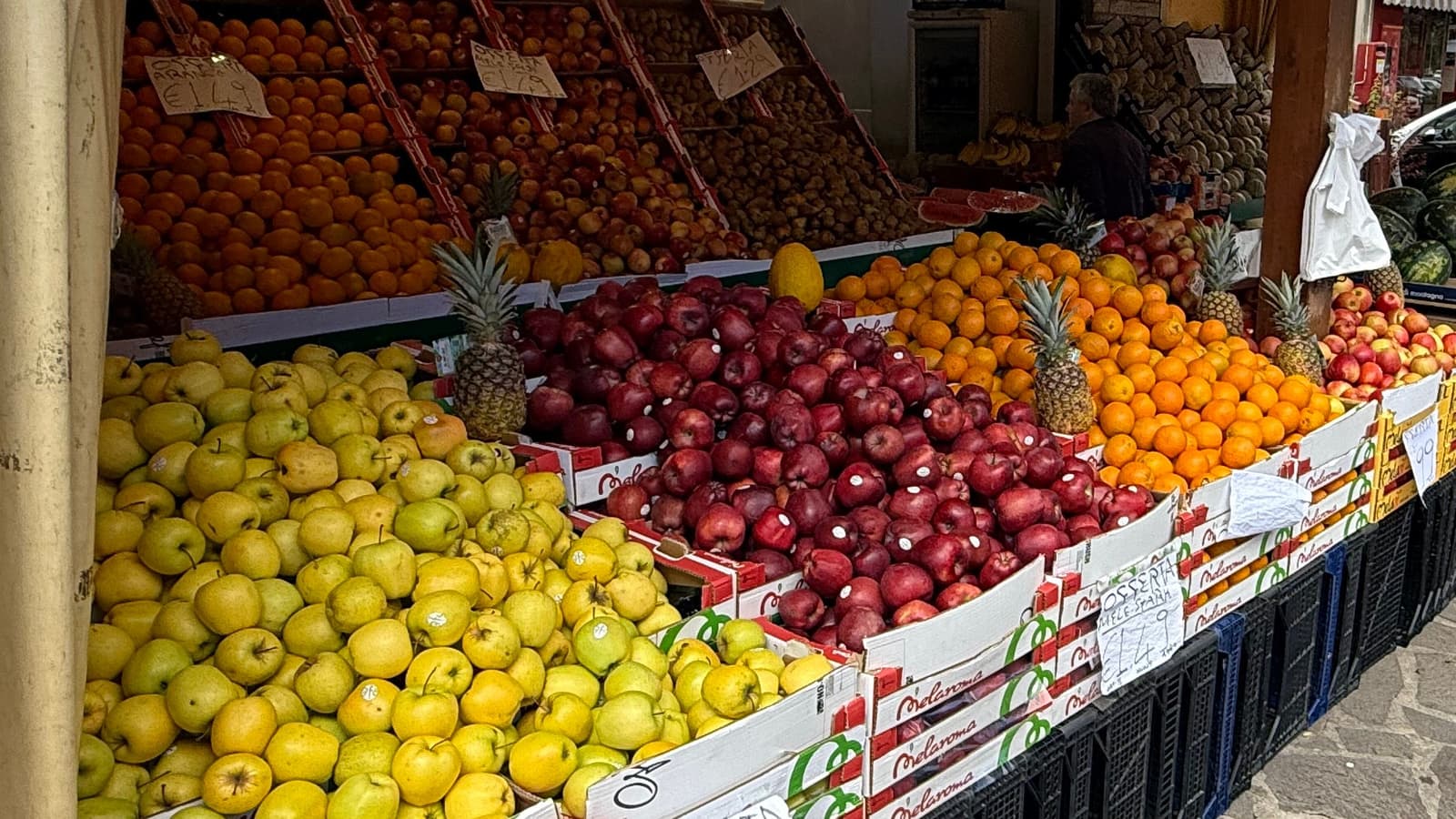
Life in Italy
The half students are still talking about a year later.
Ask anyone who has come back what stayed with them and the answer is almost never the caseload alone. It's the patients, the towns, the meals after clinic, the people they met on a train. This page is about that half — which is not a bonus attached to the clinical experience, but the thing that makes it work.
Start here
Your patients won't speak English. That's the point.
Your clinical instructor speaks English. Many of your patients won't, and at several of our sites the working language of the clinic is Italian.
For the first week that feels like a problem. Then it starts doing something to your practice. You learn to read a body instead of waiting for the history. You demonstrate rather than explain. You watch a face to see whether you have been understood, and you notice — probably for the first time — how much of your usual patient rapport was carried by fluent, easy talk.
Therapeutic alliance without shared language is a skill, and it is one you will use for the rest of your career in a country where a great many patients don't speak English either. Most students arrive expecting the clinical hours to be the education. This is the part that changes how they practise.
The shape of a day
An Italian day runs on a different clock.
Clinics generally open early and run late, with a long middle. Pranzo is not a sandwich at the desk — it is a real break, often shared, and it is where a good deal of the teaching actually happens. Expect roughly 35 to 40 hours a week, Monday to Friday, with the day's shape varying by site.
Shops close in the afternoon and open again in the evening. Dinner is late: aperitivo around seven, then antipasto, primo, secondo. Coffee comes after every meal, espresso by default, and if you order one expect it to be strong and to be finished standing up.
None of this is decoration. A health system organised around universal access, in a culture that treats the middle of the day as time to stop, produces a different clinic — different pacing, different expectations from patients, a different relationship between the team and the day.
Where you'll live
In the town, not near it.
Finding somewhere to stay is something we work out together. We know these towns well and have built up a lot of local relationships over many years, so we'll talk it through with you, point you in the right direction and help in whatever way you need. The place itself is your own arrangement, made directly with whoever you stay with, and for the vast majority of students it turns out to be easy.
Many students share with the other student at their site, and at 15 of our 25 sites you won't need a car at all. Wherever you stay will be kept cooler than you keep your home. There will be laundry on every balcony on your street, including yours. The grocery bill for two people is roughly what one person pays in America; the gas bill runs the other way.
Every site's housing, commute and cost, written out →
And what the whole thing actually changes →
What students say
"I learned a lot about Italian culture and how it affects patient care and values."
Nina Soffer, SPT · Drexel University · Istituto Clinico Tiberino
That connection — between how a country lives and how it treats people — is the one nearly every student names on the way home. It doesn't arrive in a seminar. It arrives from being in the room.
Carly Sternberg, placed in Gavinana, kept a running list of it from the week she landed. Italians are loud and expressive and they talk fast; don't mistake a passionate conversation for an angry one. They're more open with each other, freer with compliments. Roads are narrower and drivers are faster. Bidets are everywhere. There are so many dogs.
Her mentor had given her a sentence to carry before she left — it's not good, it's not bad, it's just different — and it turns out to be the most useful thing anyone can take on a placement abroad. Stop sorting the differences into better and worse, start treating them as information, and the whole experience opens up. That habit is worth as much in a clinic as it is on a street, and students bring it home with them.
Weekends
The trains are good, and most weekends are yours.
Students have gone to the Dolomites and skied all Saturday, walked the Cinque Terre coast, done Naples and Pompeii and Vesuvius in one weekend, spent Carnivale in Venice and then found Viareggio's floats better. They've seen Rome over three days and 25 miles of walking, Rimini in weather that was forecast wrong and turned out perfect, Verona and Lake Garda, Florence and Pisa, Bologna, Parma, Milan.
The point isn't that every weekend is a triumph — one student rated Florence a disappointment and was very clear about the Bologna train station. The point is that this is reachable on a Friday afternoon with a student budget, and that a year later it is what people describe first when you ask about the placement.
The calendar
August is when the country stops.
Ferragosto falls in the middle of August and much of Italy closes around it — not as a slow week, but genuinely: clinics, shops, whole towns. It is the clearest example of a culture that the schedule has to bend around rather than the other way about.
The practical side — entry rules, weather alerts, strikes and healthcare →
That's why 16 of our 25 sites don't take students in July and August. If you're aiming at a summer rotation, tell us early and we'll steer you toward the sites that run through it. The rest of the year, the calendar works in your favour — Carnivale in February, the Palio in Siena in July and August, a saint's day in every town that will close the street outside your apartment without warning.
Places available · Fall 2027