
For DPT programs
Working together on your students' clinical education.
Since 2006 we've partnered with 78 US programs to give their students a clinical experience abroad, at 25 sites across 3 countries. This part of the site is written for you, the DCE — how supervision, assessment and scheduling work, and how we support you and your students along the way.
This section
Getting to know us, and how we work together.
Working together
How a partnership unfolds
How a partnership usually unfolds — from a first conversation, through the agreement and the application round, to your student arriving at their site. And how we share the work along the way.
See how it works →Your DCE portal
Every student, at every step
A place to follow each of your students — from application, through getting ready, to their time on site — and to message them directly whenever you like.
Take a look →Questions from DCEs
The things colleagues ask us
Supervision, assessment, insurance, what students prepare before they go, costs, and how we look after students if something doesn't go to plan.
Read the answers →At a glance
The network, in a few numbers.
Weeks per rotation. 21 of our 25 sites accept a 6-week placement, so a shorter terminal rotation usually works well.
Students at a site at once, at 19 of our 25 sites; 4 at the largest. Your student gets their CI's real attention.
Sites open year-round. The other 16 pause for ferragosto in July and August.
Sites needing no visa for US citizens on a stay of 90 days or less. We're happy to check the details for any site you're considering.
Supervision and assessment
Teaching, on your terms.
Clinical instructors
English-speaking, and trained on your instrument
Every CI we place a student with speaks English. Assessment runs on whichever tool your program uses — the electronic CPI including CPI 3.0 is the most common, and we work with the other instruments in general use, so the assessment comes back to you in a form you know. Our CIs are teachers at heart, and several sites run structured weekly teaching alongside the caseload.
Hours
Typically 35–40 per week
Monday to Friday, with the clinic day varying by site. If your program needs additional hours, some sites can add weekend time — just ask and we'll check with the site.
Site readiness
Safety training and dress code
At 21 of our sites, Italian law (D.lgs. 81/2008) asks interns to complete workplace safety training: a 4-hour general course plus a 12-hour healthcare-specific course, completed before the first clinical day. We walk each student through registering with our training partner, Phisiovit, and the student pays the course fee (EUR 185 plus 22% VAT, EUR 225.70) to them directly. 25 sites have a dress code. We help students with both well before they arrive.
Looking ahead
Ready for CEBE
Competency and entrustment-based education is changing how clinical performance gets judged, and an international placement is exactly where entrustment decisions get interesting — an unfamiliar system, an unfamiliar language, and a student who has to be trusted to act. We are set up to assess against entrustable professional activities (EPAs) alongside the instruments in use today, and a partner program pilots it with us from spring 2027. If your program is moving to CEBE, we'd love to hear how you're approaching it — we'd much rather build this alongside our partner programs than on our own.
Clinical reasoning support
Meridian, free on placement
Every student we place can use Meridian free until their placement ends, with code EGU2027: 80+ evidence-aligned clinical best practice pathways, a clinical reasoning mentor and chairside tools, in English and Italian. It is decision support beneath the clinical instructor, not a substitute for supervision or for your program's assessment.
On the ground
A team in-country
Our Vice President of European Operations and Senior Director of Student Services are both based in Italy and both practising physiotherapists. If a student needs someone, the person who answers is nearby — not eight time zones away.
Settings and caseload
Mostly outpatient, with inpatient options too.
The network skews outpatient orthopedic and sports, which suits most terminal rotations, alongside a good range of other settings: post-acute rehabilitation wards with brain injury, stroke and spinal cord injury; a large regional hospital; skilled nursing; a cardiopulmonary inpatient site; a leading hand centre; and a practice covering pelvic floor.
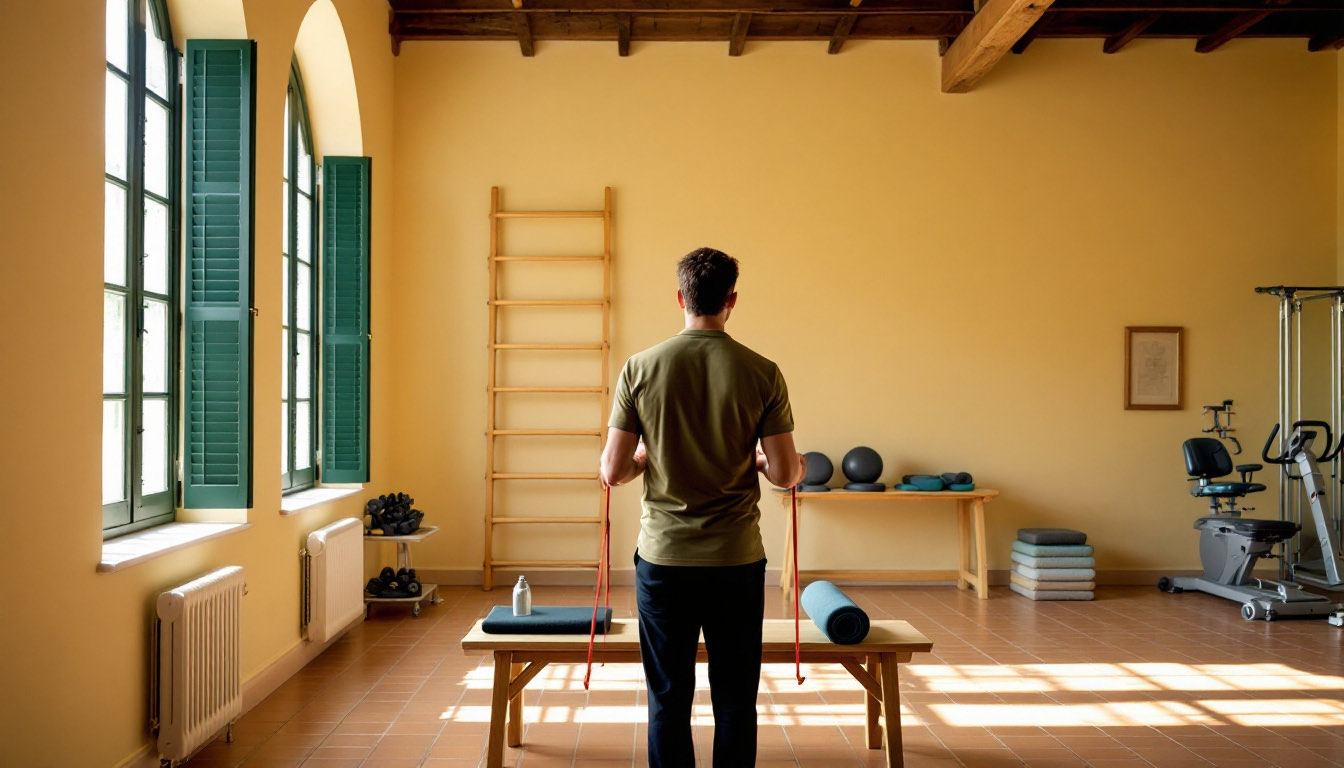
Every site page describes its settings, patient populations and caseload, along with housing, commute and cost — so you can see how a site fits your curriculum before a student applies.
Other professions
Occupational therapy and athletic training.
Our network grew up around physical therapy, and it's growing. We have occupational therapy availability at Ospedale San Giuseppe in Milan — a hand and wrist centre, surgical and non-surgical, where students also learn splinting — which suits an OT hand rotation unusually well.
We are also exploring placements for athletic trainers. Nothing is running yet, and we'd like to shape it together with program directors who know what a good AT clinical experience looks like. If that's your field, we'd love to hear from you while it's still taking shape.
Getting started
Our affiliation agreement.
Our partnerships rest on a clinical affiliation agreement written for international placements. Because we work on behalf of our partner clinics in Italy, Switzerland and Luxembourg, rather than being a clinic ourselves, we use our own agreement instead of a school's standard facility form. The upside for you is simplicity: one agreement with us covers every site in the network, and you have one point of contact for all of them.
It covers the things a placement abroad needs: student data handled under FERPA and, where it applies, the EU's General Data Protection Regulation; the professional insurance required in the host country, which we provide; health insurance valid abroad, including evacuation home; and the clinical standards your accreditation looks for. It runs for five years. We're glad to send it whenever suits you, and to talk it through with your risk or contracts office.
First
Tell us a little about your program — the rotation length, the term you're planning for, roughly how many students — and we'll suggest sites that fit.
Then
We'll share the detail on those sites — caseload, CIs, supervision, hours, and how we'll support your student day to day.
In parallel
We'll send our affiliation agreement for your review, and help your students prepare for anything their site asks of them — safety training, dress code, documents — well before they leave.
Places available · Fall 2027
We have room for students this coming fall.
Applications for 2028 open 1 January 2027, and Fall 2027 places are open now — just get in touch.